
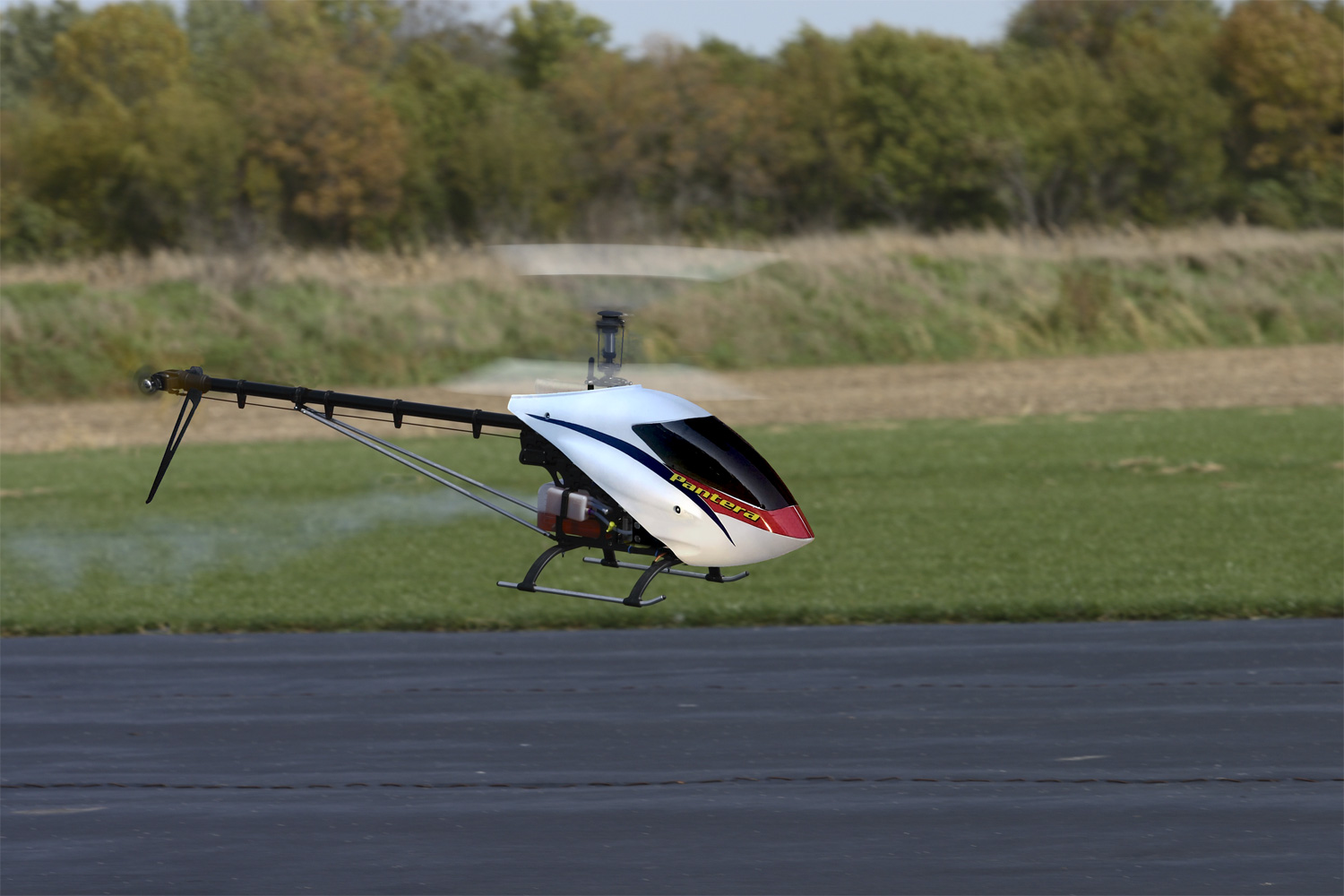
If we flew at the same field and you asked my advice, what I'd recommend servo-wise would depend on if you're a sport/scale pilot, or one oriented toward hotdogging and performing 3D maneuvers.
Moreover, while light weight and high quality are givens – as is plenty of torque – the major difference is this . . . the 3D guys will kill for super fast servos.

Servo performance parameters
The four 'important' parameters when selecting servos are weight, torque, transit speed, and price.
Cyclic servos outputting 250oz-in offer plenty of torque for 600-class models (and enough for 700-class). The only time you benefit from more powerful servos are if;
- you're God's gift to flying hard maneuvers
- you're toting a weapons or camera package
- you're flying a heavyweight scale model
Otherwise, you're pissin' money away getting something more powerful because you won't feel the difference.
Proof? Collective imposes the greatest load. Since three servos are working in synchronicity, then you have 250oz-in x 3 = 750oz-in to work with. Accounting for the improved leverage of 20mm arms (servos are rated at 25.4mm), then with a bit of grade school, it turns out you're actually bringing to bear a touch over 950oz-in
- [(25.4mm/20mm) * 750oz-in] = 952oz-in
. . . this is the real world! And against a 120oz model? 250oz-in it's a gracious plenty!
Transit speed
When it comes to transit speed, it is a totally different story. Basically, if you fly 3D, you cherish high speed servos because maneuvers and changes in direction happen in the blink of an eye. You simply can't pull that stuff off with normal speed servos.
Thing is, fast servos cost more money. If you're not doing those kinds of maneuvers, then you can save a lot of money!
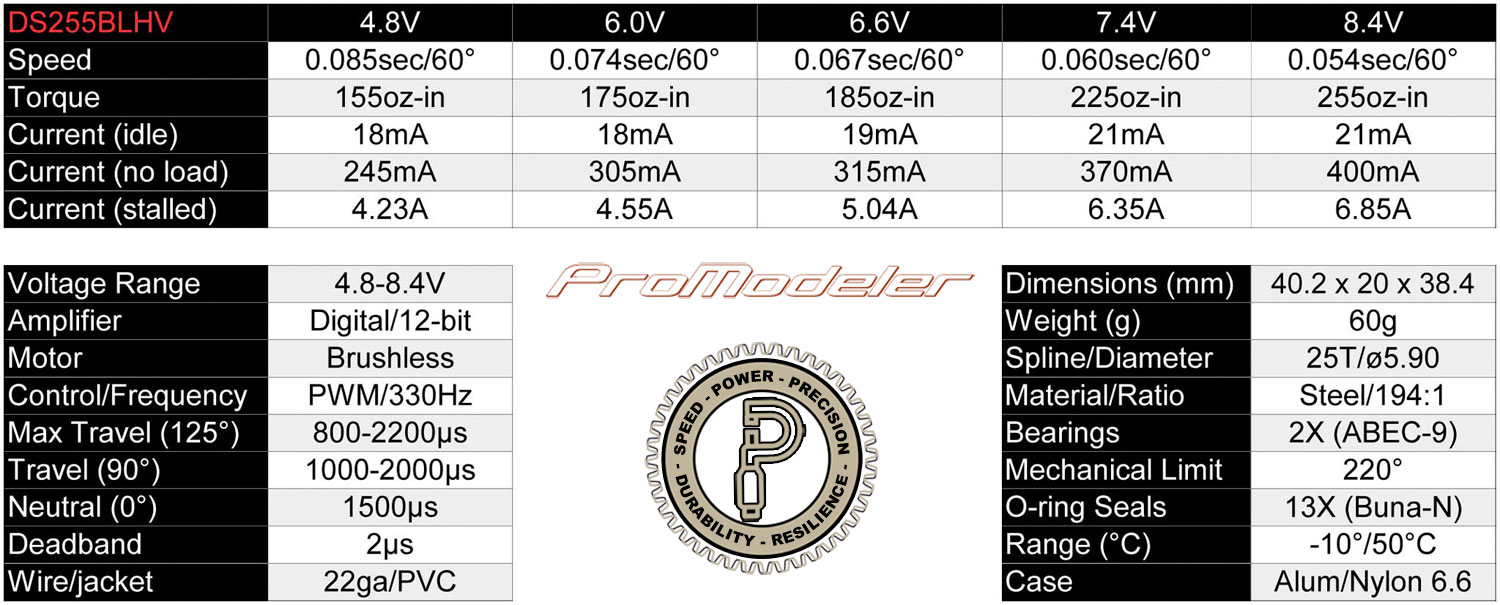
Let's be clear . . . high speed servos don't matter for sport and F3C type maneuvers because you can't feel the difference – not even if your soul depended on it!
Point being, if performing maneuvers off the F3C schedule is your cup of tea (loops, rolls, pirouetting turns, and inverted work) then don't pay for servos where the only difference you'll feel . . . is in your wallet!
Anyway, what follows is our servo recommendation based on – you – as a pilot.
Sport pilots
Since as a general rule, sport pilot aren't into risk taking (e.g. the only time they come within inches of the ground is during landing and takeoff), and because they're mostly flying the model one, or even two mistakes high, and usually performing relatively straightforward F3C-type maneuvers, then my advice regarding the best servos is . . . get the Budget Build package because they've been curated with this type of maneuvering in mind.
What you'll get are three DS270BLHV, a DS135BLHV for tail rotor, and a DS90DLHV for throttle. Plus three PDRS20-25T servo arms, a PDRS15-25T for tail rotor, a B2S5200D battery pack, and a 5A slide switch (nit-noids needed for readying your model for flight).
Note; links go to the ProModeler website for a deep dive into the specs.

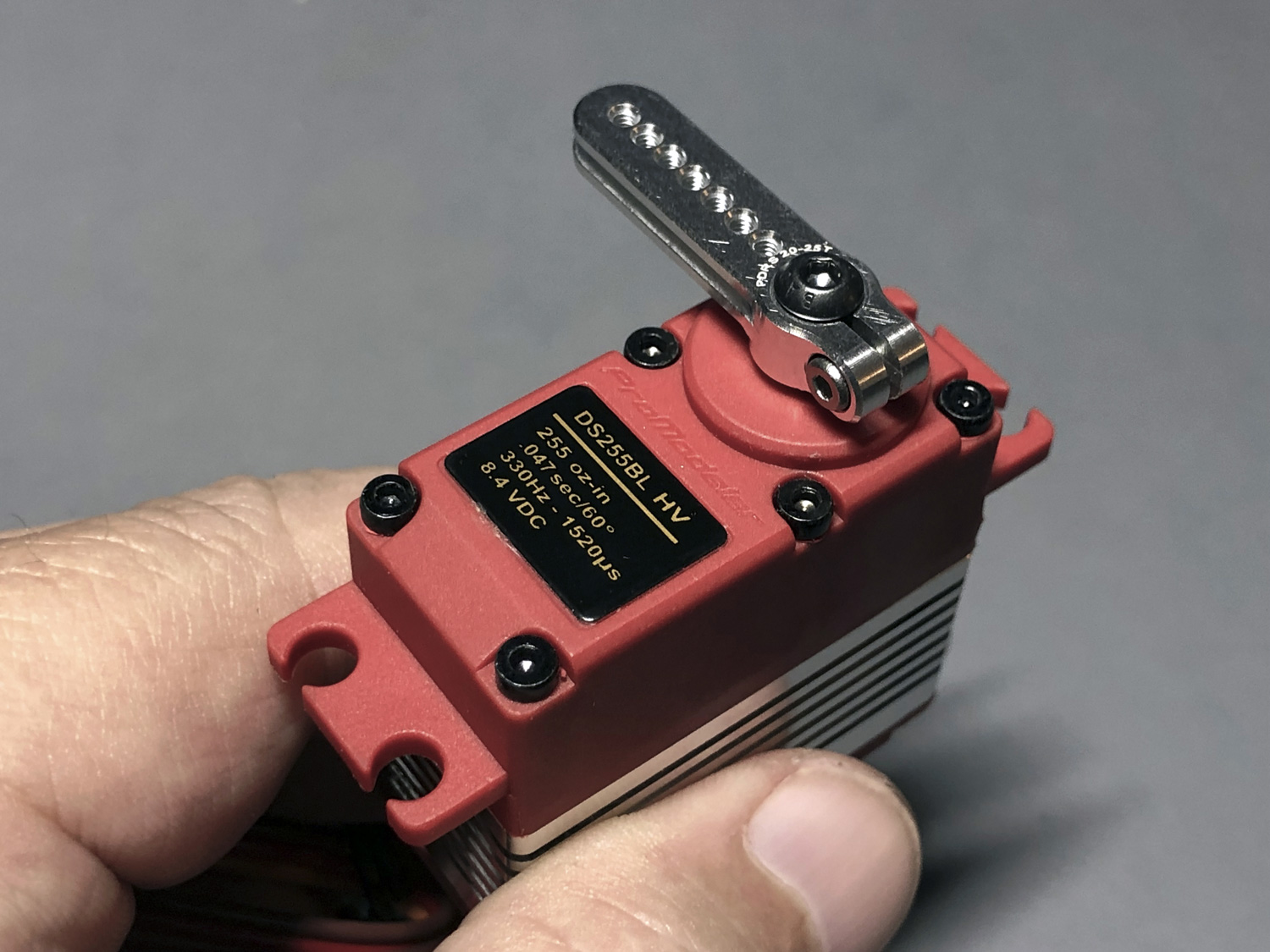
Externally, DS270DLHV servos look exactly the same as the DS255BLHV recommended for 3D-oriented pilots. Both consist of a lightweight finned alloy center (for optimal cooling), and polymer upper and lower case sections (to hold down weight). They're held together with 10 Allen head bolts, and are sealed against environmental intrusion by thirteen o-rings!

Note; what recommends ProModeler servos over others is they're principally marketed to defense contractors. As such, and unlike ordinary hobby-grade servos, they're built to several MIL-STDS, to include;
MIL-STD-810H
- Shock - Test Method 516.6
- Humidity -Test Method 507.5
- Vibration - Test Method 514.6
- Acceleration - Test Method 513.6
- Sand and Dust - Test Method 510.7
- Water Intrusion - Test Method 514.5
- Altitude <70,000’ - Test Method 500.6
- High Temperature - Test Method 501.5
Most important for heli pilots are test methods 514.6 (vibration), 516.6 (shock), and 513.6 (acceleration). Reason being servos are mounted near an engine operating in the range of 17,000RPM. That, and they're subject to getting a mighty thump during a crash! Your money, so chose wisely.
Note; although pilots of electric models like to believe there's no vibration, they'd be mistaken because imperfectly balanced electric motors, as well as tail rotor and main rotor blades, are incredible sources of vibration. Ditto the maneuvers themselves as cyclic and collective inputs result in harsh loads on the airframe.
Proof comes by taping a mobile phone running a free vibration app, then go for a flight – you'll see! No, absolutely not saying a nitro model doesn't vibrate more, saying electric models also have intense vibrations to protect against. Heads up.
Next, as regards servos recommended for cyclic and throttle, eyeball this photo to get an idea of the measures taken against vibration. The white stuff all over the PCB and motor terminals? That's potting compound.

Sporting the consistency of grease when applied, it flows in between electronic components, then as it hardens, they're encased. As a consequence, they're better protected from vibration and shock. And if the thought crosses your mind, this is a great example showcasing where hobby grade servos don't go the extra mile.
3D-oriented pilots
In a similar vein, if you’re pushing the envelope maneuver-wise, then my opinion regarding 'best for you' are the servos within the Sport/3D package. This includes three DS255BLHV for cyclic, another DS255BLHV for throttle, plus the same DS135BLHV for tail rotor.
The DS135BLHV in particular is a lightweight speedster with incredible transit time!
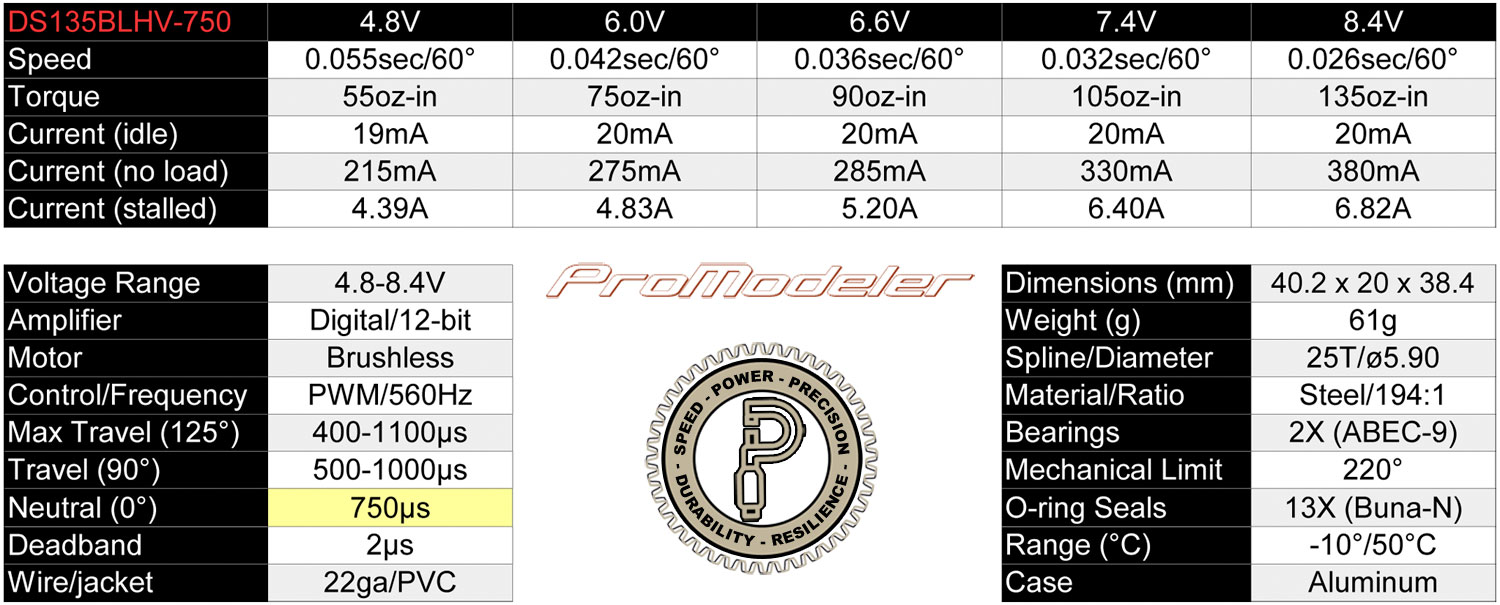
Note; the DS255BLHV and DS135BLHV are sister servos. Means other than gear ratio and motor, mechanically they're built the same-same. Thus, when you've seen one, you've seen the other.
What's more, the gear trains of these, as well as servos in the Budget Build package, are both outfitted with durable stainless steel gear – best money can buy!

And eyeball just to the left of the photo where the bronze hardpoints are insert molded. These are for the steel gear shaft ends (what supports the gears in the transmission section). By using inserts, you end up with a harder interface between shaft and case than a plain aluminum case (like imports) where the shafts are embedded straight into aluminum.
Note; reason lightweight ProModeler servos are equipped with polymer cases is they're as durable as aluminum up to 400oz-in (because of the bronze inserts molded into the case as reinforcements) but significantly lighter.
Anyway, the Sport/3D package – like the Budget Build package – includes the same nit-noids, except you get the more compact B2S2600 flight pack, which substitutes the higher capacity B2S5200D to save weight.

Note; both the 2600mAh and 5200mAh battery packs share the same rugged construction – cells contained within round metal shells. This, because the steel is effectively armor, which amounts to an extra ounce or two compared to cells packed in plastic bags (LiPo). We feel the added safety against the added fire risk is a no-brainer.
Battery leads
Why so many leads on the battery pack? It's for the added versatility. And honestly? The weight of the added leads is inconsequential – but – could be worth their weight in gold.
For example, if scale models are your 'thang' then having an additional lead for the lighting controller for marker lights comes in handy. True for 3D models outfitted for night flight, also!
Mixture servo
Unique for having where to mount a mixture servo, the P6 makes great use of the three available optional servo mounts. Moreover, it doesn’t matter whether you fly sport, or 3D-maneuvers because your benefit is huge in;
- not having to land to make adjustments, and
- in the event of an engine-emergency (for example, the pressure line slips off the muffler).
Adjusting the air-fuel mixture in flight before your engine is damaged is a very, very nice P6-benefit.

Anyway, for both sport and 3D, the DS90DLHV servo for mixture is all you need because speed is of little consequence (unless you're God's gift to flying and have the reflexes of a mongoose). Only then, 'maybe' get another DS255BLHV for mixture, instead. In the alternative, you're either fooling yourself or comfortable pissing money away with the faster servo enough not to care about the added expense.
Recapping, we're making suggestions regarding the right avionics package for you, but because we don't know you, then we hope you know yourself well enough to do what's best for you. Or put another way, if you order the Budget Build servo package because it's cheaper while in the back of your head you're thinking maybe to try your hand at 3D some day, don't subsequently come bitching because servos perfect for a club pilot won't cut it when you're trying to perform piroflips. Like whose fault is it?
After all, we're telling you straight up which servos to get, and why!
Gray areas - Hard/3D, UAS/Scale, Ultimate/3D
Problem with this kind of white paper comes because there's no such thing as one-size-fits-all (servo-wise). So now let's delve into the gray areas.
While money could be fairly said to define the difference between a Budget Build package and the Sport/3D package, there's a bit of gray between Sport/3D packages, Hard/3D package, and Ultimate/3D packages. To address these needs we offer packages custom tailored to those of you with more specialized requirements.
Like with racing – power and speed costs, and added dough can be significant!
Hard/3D package
What differentiates the Sport/3D from the Hard/3D package is principally more torque. Thus, you get the more powerful DS415BLHV for the three cyclic servos, instead of the DS255BLHV. Otherwise, same-same.

Note; nit-noids are also the same as in the Sport/3D package. Who defines Sport/3D vs Hard/3D? You do!
UAS/Scale package
Another gray area comes as regards AUW (all-up-weight). This is because to the servo, there's actually no difference between a 15lb scale-model (or a similar weight UAS loaded with camera or munitions plus a spool of fiber optic cable). Changing directions, even in a comparatively gentle manner, 15lb air frames are very similar to the loads imposed when a 3D-pilot is making his 8lb model dance across the sky. Anyway, for these kinds of loads we offer a package specially tailored to more weight, the UAS-Scale package.
Point being, while sometimes scale-oriented pilots benefit from the DS415BLHV servo used in the Hard/3D package (when the model with fuselage only weighs in at 11-12lbs), when a model's goes into the 15lb range, now the more powerful all-alloy DS505BLHV servo comes into its own.

But with a set of these, be prepared to get off your wallet because they're pricey by any definition!
Anyway, if fitting your model into a scale fuselage is in your future, and you can afford it, then definitely consider this as our best package for the purpose of sport and scale modeling.
Ultimate/3D package
Who needs the servos in the Ultimate/3D package package? Honest to God, we don't know. But enough folks inquired we decided to put together a package to make it easy. We suspect those who equip their model with these tend to be a little gonzo nuts about wanting the quickest most power servo on Earth.
Best in the world? ProModeler makes it . . . it's the DS635BLHV.

And note, the tail rotor and throttle servo in all the 3D-oriented packages remain the DS135BLHV and DS255BLHV respectively. Battery, and other nit-noids are the same also – except – now the cyclic horns are PDRS25U-15T instead.
Note; the mount position for cyclic arm balls is designed for 20mm.

Wrap up
The best servo for you is defined by the maneuvers you tend to fly. For 3D, you want faster servos than for the smooth F3C type maneuvers favored by sportsmen. Sport/3D servos are for folks flying most 3D maneuvers. If you fly hard 3D, then the Hard/3D package is best for you (and for medium weight scale). And for UAS and heavyweight scale, then you want more powerful servos because models can readily weigh twice as much as a naked version. Finally, the Ultimate/3D package is for those of you who are inventing maneuvers and need the best servos money can buy.
Last thing; if you don't know jack about servo motors, then review the About RC servo motors article where various types of servo motors are cut open on a lathe. Along with close up photography, you'll learn what makes them different from each other. And most importantly, what makes one type of motor better for 'you' than another.


